
Attio published a map for modern go-to-market. It isn't a playbook. It's a category move.
Reading nine operators converging on one role, and what it tells us about the discipline of GTM engineering finding its footing.

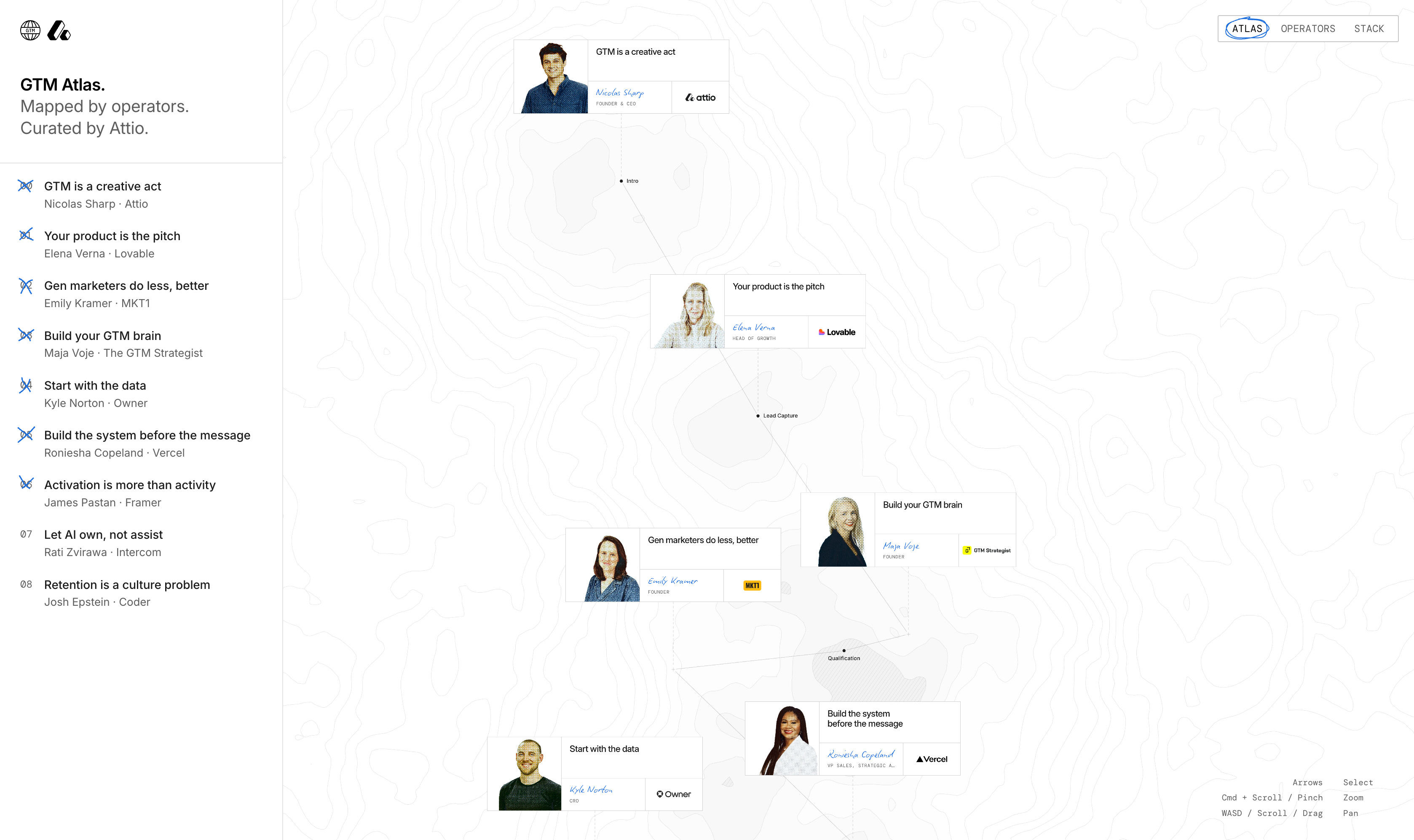
Earlier this week, Attio (the AI-native CRM company that’s been quietly building one of the more interesting positions in B2B software) published something called the GTM Atlas.
It’s a free, ungated, web-based resource. Nine chapters by nine operators, covering the full customer journey from lead capture to retention. The contributors are a who’s who of operators in companies most B2B builders are watching right now: Vercel, Framer, Lovable, Owner.com, Intercom, MKT1, plus respected solo voices like Maja Voje and Josh Epstein.
The framing is unusual. It isn’t a course. It isn’t gated. It doesn’t read like vendor content. The intro by Nicolas Sharp (Attio’s founder) explicitly calls it a “map for modern go-to-market” rather than a playbook, and tells you to skip to whatever section is relevant to where you are.
It’s worth reading the whole thing if you have an hour. What follows is my best attempt at telling you what’s in it, what stood out, and what I think it actually means for anyone building or thinking about a GTM motion in 2026.
The nine chapters, in one paragraph each
Sharp opens with an intro called “GTM is a creative act.” His thesis: AI has collapsed the gap between hypothesis and working system. The era of “buy Salesforce, copy the playbook, hire a RevOps lead” is dead. What replaces it is each company building its own system around its own thesis about its own customer. Less template, more judgment.
Elena Verna (Lovable) writes on lead capture under the title “Your product is the pitch.” Her argument is product-led: in 2026, the website and the product are the demo, the marketing, and the qualification all at once.
Emily Kramer (MKT1) covers qualification with “Gen marketers do less, better.” Her core point: stop doing random acts of marketing. Most early teams say yes to every founder request and copy what other teams do. The teams that win pick a few big-bet campaigns, integrate content (fuel) and distribution (engine), and let a single generalist orchestrate end-to-end.
Maja Voje (The GTM Strategist) writes a second qualification chapter, “Build your GTM brain.” It’s the most strategic of the chapters: how to build a layered understanding of your market that holds up as the product evolves.
Kyle Norton (CRO at Owner.com, where he scaled GTM from $2.5M to nearly $100M ARR in under four years) covers outbound in “Start with the data.” His thesis is uncompromising: outbound has one point of failure, the data. Bad lead lists make every other intervention worthless. AI’s job is to remove wasted motion, not to send more emails.
Roniesha Copeland (VP Strategic Sales at Vercel) writes the second outbound chapter, “Build the system before the message.” Process before craft.
James Pastan (Head of Growth at Framer) covers activation: “Activation is more than activity.” Pushing back against the idea that engagement metrics equal real value.
Rati Zvirawa (Senior Director of Product at Intercom) covers conversion with “Let AI own, not assist.” The argument: in customer-facing AI, the line between “AI assists a human” and “AI owns the workflow” is the line between toy and product.
Josh Epstein (CRO at Coder) closes with retention: “Retention is a culture problem.” Most retention failures aren’t dashboard problems, they’re org problems.
That’s the Atlas in one breath. Each chapter is short, focused, and written by someone who’s actually shipped the thing they’re writing about. The site itself is a beautiful interactive map, worth seeing for the design alone.
The thing nobody is saying about this Atlas
When you read all nine chapters in one sitting, a pattern emerges that I haven’t seen mentioned in any of the relays I’ve read.
Every chapter describes the same role under a different name.
Kramer calls it the “gen marketer.” Norton calls it the “GTM engineer.” Voje calls it the “GTM brain.” Sharp calls them “operators with a clear point of view.” Strip away the vocabulary and you get the same job description across all nine: one human who owns the data layer, owns the system layer, owns the message layer, and translates a founder’s belief about the customer into a working machine.
This convergence is the news. The Atlas isn’t really nine essays on nine topics. It’s nine arguments for the same role, dressed in nine different hats.
That role doesn’t have a settled name yet. Three years ago it didn’t really exist as a discipline. People doing this work were scattered across titles like Head of Growth, Marketing Ops Manager, Head of Demand Gen, RevOps Lead, sometimes a founder doing it themselves on the side. The work was happening, but the category wasn’t.
The Atlas crystallizes the category.
Why a CRM company published a guide that isn’t about CRM
Here’s the strategic move underneath, and I think it’s worth naming.
When a software company publishes a 9-chapter resource featuring nine respected operators, the default assumption is that it’s lead gen. SEO. Top of funnel.
The Atlas is something else. It’s a category-defining document. Sharp’s intro lays out a thesis (AI has collapsed the gap between hypothesis and system, the playbook era is over, GTM is now a creative act) and the rest of the Atlas reinforces it through nine independent voices.
Why does that matter? Because if you accept the thesis, you also accept its corollary: the monolithic CRM (the kind designed for one playbook, one process, one set of standardized handoffs) doesn’t fit anymore. What fits is a composable stack. Tools that let each company build its own system around its own thesis.
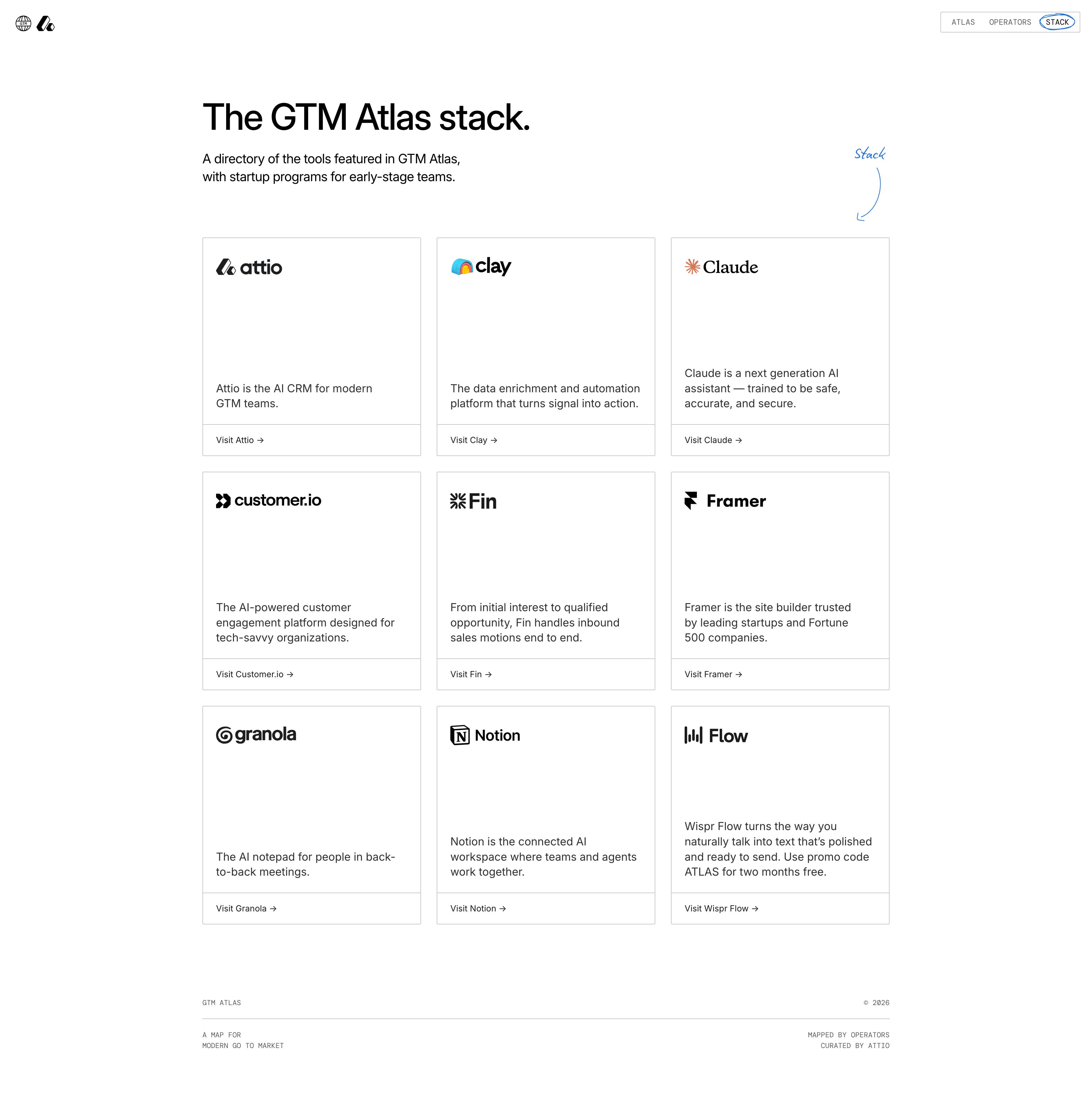
The Atlas’s Stack page lists the tools featured: Attio, Clay, Customer.io, Claude, Notion, Framer, Granola, Fin, Wispr Flow. There’s no Salesforce. No HubSpot. No Outreach. No Marketo. The implicit message is that the legacy stack belongs to the era the Atlas is declaring over.
This is how categories get redrawn. You don’t compete on features. You publish the manifesto, you let nine respected operators give it social proof, and you let the worldview do the work.
What to take from this if you’re building a GTM motion right now
Three things.
One: don’t hire a BDR before you have a system. This is Norton’s argument and I think it’s the most important practical insight in the whole Atlas. Reps fail not because they’re bad. They fail because the data they’re working with is unusable. Most early-stage teams hire bodies before they hire (or build) the layer that makes those bodies productive. That order is wrong.
Two: stop looking for the playbook. Sharp’s framing is correct: there isn’t one. The teams that win in 2026 won’t be the ones who copied the right template. They’ll be the ones who built the system that fits their specific belief about their specific customer. Borrowing tactics is fine. Borrowing entire models is now a competitive disadvantage.
Three: name the role you’re actually trying to fill. If you’re hiring “Head of Marketing” but what you actually need is someone who can wire your CRM to your enrichment to your lifecycle automation and run end-to-end experiments with AI-generated assets, write that JD. The Atlas just gave you the vocabulary. Use it.
A closing note
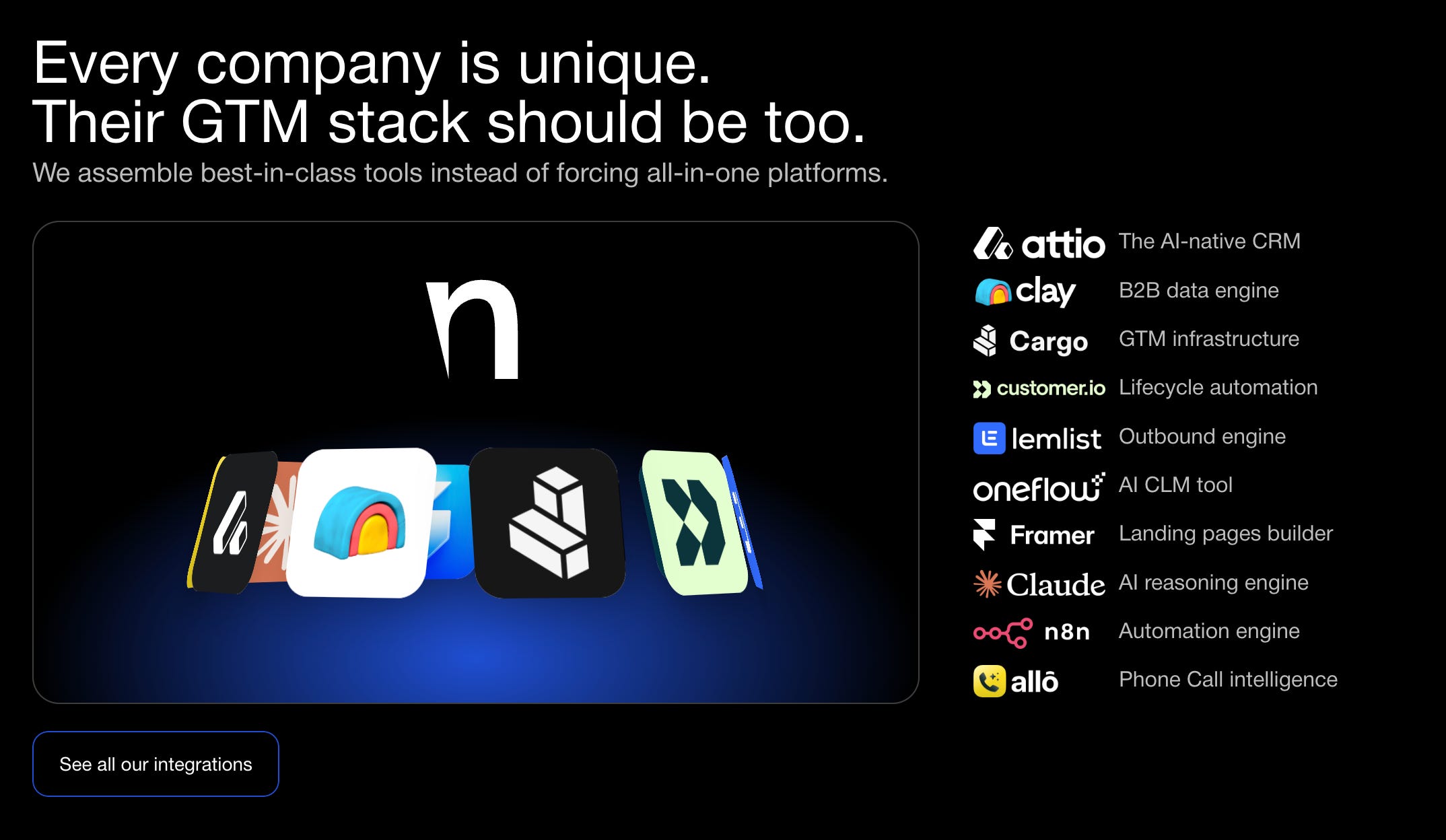
Disclosure: I run Novlini, a GTM and RevOps consultancy that operates inside the ecosystem the Atlas describes. Attio, Clay and Customer.io are the three core tools of our stack, and we are official partners with all three. We picked them by conviction first, the partnerships followed.
I’m not a neutral observer of this document.
But for two years I’ve been having the same conversation with founders, explaining why a composable stack beats a monolithic CRM, why one operator with a strong point of view outperforms five specialists with handoffs, why the playbook era is over and what replaces it.
The Atlas is the first time I’ve seen that conversation written down by people other than me, with social proof attached.
That’s why I think it matters. Not because it teaches anything radically new, but because it names what was already happening. And in this industry, naming things is half the battle.